
How do we regulate AI when the future is a moving target?

The report “Regulating Under Uncertainty” by Florence G’sell and the Stanford Cyber Policy Center explores one of the hardest problems in AI governance: how can regulators make rules about technologies that are still evolving and whose impacts are largely unknown? The authors argue that traditional regulatory approaches, which assume a stable understanding of risks and benefits, may not work well for AI. Instead, they suggest that regulation must adapt to ongoing uncertainty, especially when the social, ethical, and economic consequences of AI remain unpredictable. They highlight the dangers of over-regulation, which could stifle innovation, as well as under-regulation, which could leave society exposed to serious harms.
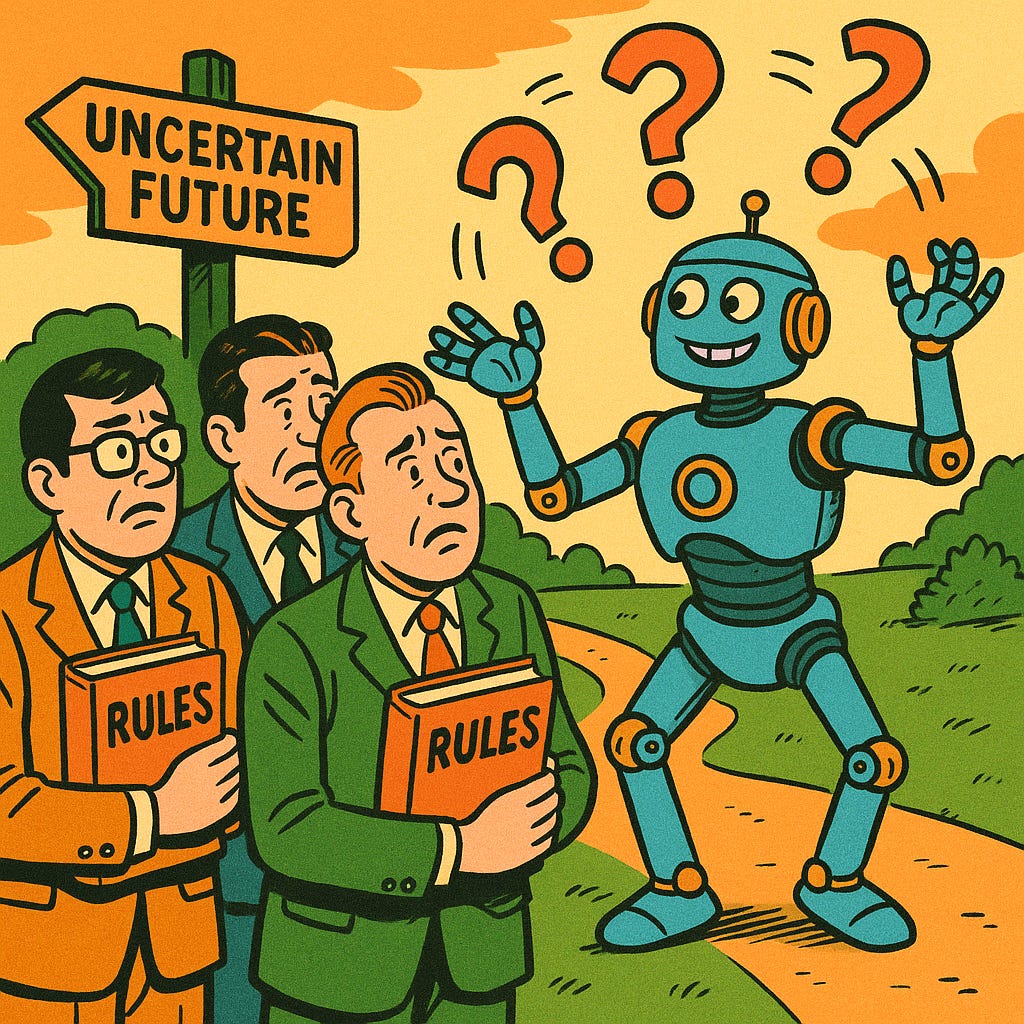
A central claim of the report is that regulators should embrace flexibility by designing rules that can be revised as evidence emerges. This could include sunset clauses, pilot programs, and mechanisms for ongoing monitoring. However, this approach assumes that regulators will have both the technical expertise and political will to adjust rules in real time. That is a big assumption. Governments are often slow-moving, subject to lobbying pressures, and constrained by legal processes that make rapid adaptation difficult. While the authors present adaptive regulation as a promising path forward, the practicality of such responsiveness remains unknown.
Regulation must be designed to evolve alongside technological developments, but this requires institutions that are not only technically competent but also agile enough to respond quickly to shifting risks and opportunities. Without such agility, regulatory frameworks risk becoming obsolete just as quickly as the technologies they aim to govern.
The article also emphasizes that uncertainty is not just a scientific problem but a social one. Different stakeholders—tech companies, civil society groups, and governments—may interpret the same uncertainties in very different ways, depending on their incentives and values. This complicates the idea of building flexible regulations that everyone can trust. Moreover, the authors seem to assume that uncertainty will diminish over time as more data becomes available, but history shows that some uncertainties—like those around AI bias or long-term economic impacts—may persist indefinitely or even grow more complex.
In the end, the article leaves readers with an important tension: regulation under uncertainty requires experimentation and flexibility, but the institutions tasked with regulating AI may not be well-equipped to do either. The authors provide a strong case for adaptive governance but perhaps underplay the structural barriers to making it real. Their vision is forward-looking but rests on a hopeful assumption that regulators will overcome political, bureaucratic, and economic inertia. This is less a roadmap than a provocation: can our institutions evolve quickly enough to keep pace with AI’s uncertain future?