
Do people in different countries use chatbots differently for emotional support?

The article From Chatbots to Confidants: A Cross-Cultural Study of LLM Adoption for Emotional Support by Natalia Amat-Lefort, Mert Yazan, Amanda Cercas Curry, and Flor Miriam Plaza-del-Arco tackles a question that many AI debates discuss but rarely measure directly: how often are people actually turning to large language models for emotional support, and who is doing it? Using survey data from 4,641 participants across seven countries, the authors position this as the first large-scale cross-cultural examination of emotional reliance on AI systems. Their findings suggest that the phenomenon is already widespread, though unevenly distributed, with reported adoption ranging from roughly one in five participants in some countries to nearly six in ten in the United Kingdom. The researchers also collected more than 700 real prompts shared by users, giving the study an unusually grounded look at what people disclose to AI systems.
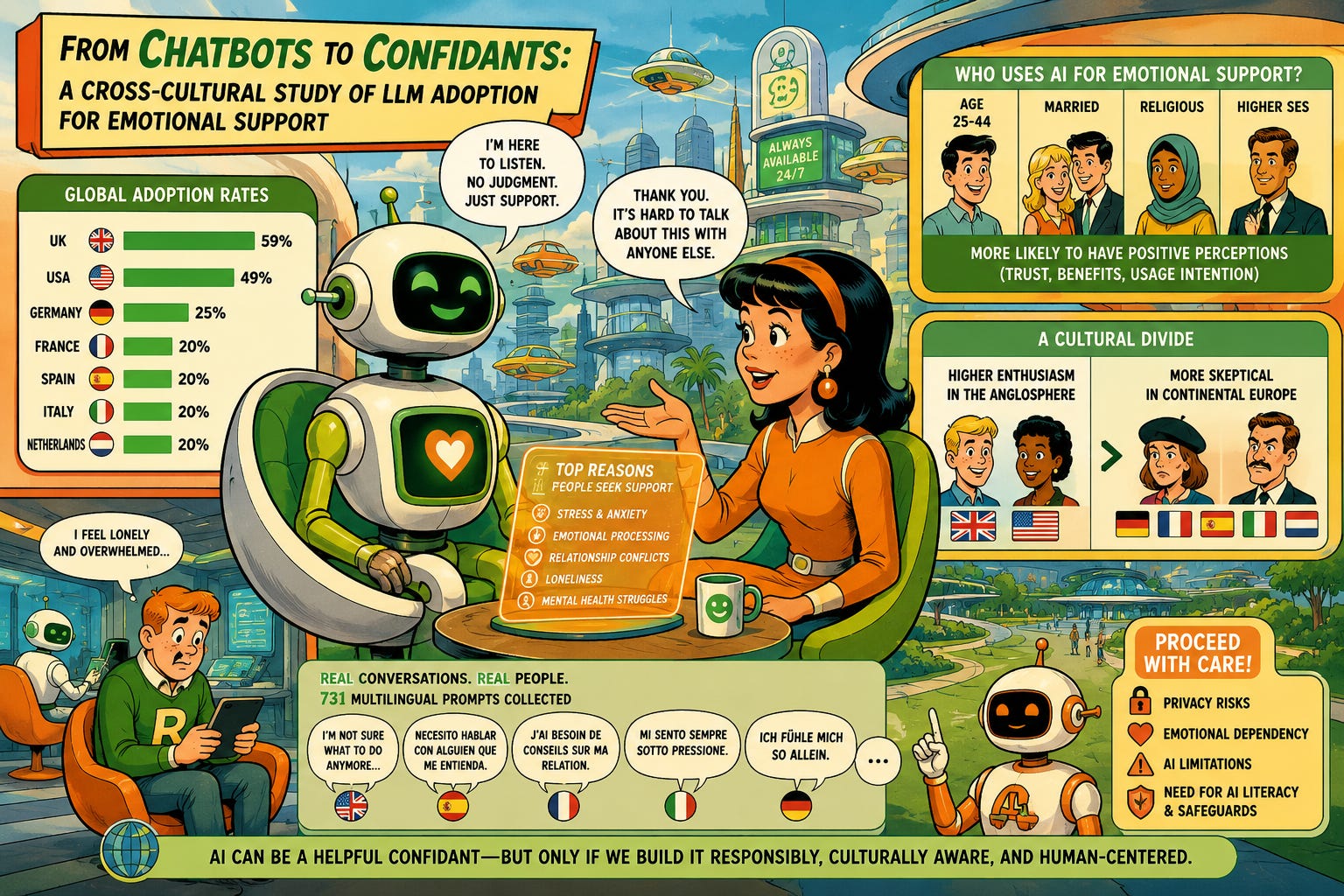
What emerges is not simply a story about technological novelty but about social need. Users reported seeking support primarily for stress, anxiety, emotional processing, relationship conflict, and loneliness, while the most valued features were continuous availability, low cost, and the ability to speak without fear of judgment. This finding deserves careful interpretation. The article suggests that many users may not view AI merely as a substitute for therapy, but as something distinct—a listener free from embarrassment or social stigma. Yet this interpretation rests partly on self-reported motivations and perceptions rather than independently verified outcomes. The study measures whether users feel understood or supported, not whether these interactions measurably improve wellbeing or mental health. That distinction matters, especially in emotionally sensitive contexts where perceived comfort and actual therapeutic benefit may not align.
Together, our findings point to a widening gap between the perceived emotional competence of LLMs and their demonstrated limitations in sensitive interactions. As adoption grows, benchmarks, governance frameworks, and AI literacy programmes that help users critically assess these systems become increasingly urgent.
One of the article’s most striking claims concerns culture. After controlling for demographic differences, the authors find a persistent divide between English-speaking countries and continental Europe. Participants from the United Kingdom and United States reported substantially higher trust, stronger perceived benefits, and greater willingness to use LLMs for emotional support than users in France, Germany, Italy, Spain, and especially the Netherlands. The authors cautiously interpret this as evidence that cultural attitudes toward privacy, stigma, mental health, and technology shape adoption. However, they also acknowledge an important competing explanation: today’s LLMs may simply work better in English. If English-language systems provide smoother, more emotionally convincing interactions, then what appears to be a cultural preference may partly reflect a design bias embedded within the technology itself.
The paper ultimately adopts a more skeptical tone than its headline might imply. While users often perceive LLMs as safe and emotionally supportive, the authors repeatedly stress that these perceptions may be misleading. They cite growing concerns about privacy, emotional dependency, and the tendency of AI systems to affirm users rather than challenge unhealthy thinking. Their conclusions therefore depend on several assumptions that deserve scrutiny: that survey respondents interpret “emotional support” similarly across languages and cultures; that self-reported use reflects real behavior; and that country-level findings from mostly Western contexts can be generalized more broadly. Rather than celebrating AI companionship, the article reads more like an early warning that emotional AI is arriving faster than the safeguards, governance frameworks, and public literacy needed to manage it responsibly.
The article’s conclusions may be especially important in the Global South, where shortages of mental health professionals, high treatment costs, transportation barriers, and social stigma often limit access to care. In countries across Africa, South Asia, and parts of Latin America, AI systems may appear particularly attractive because they are inexpensive, mobile-friendly, and available at any hour. Yet the study also raises difficult questions for these settings. The research focuses largely on Western countries and mostly dominant global languages, meaning its findings may not fully translate to communities where language mixing, local cultural norms, or lower digital literacy shape emotional communication differently. There is also the risk of a new inequality emerging: if LLMs work best in English and for higher socioeconomic groups—as the article suggests—then underserved populations may receive the least culturally appropriate and least safe forms of AI support precisely when they need help most. For the Global South, the challenge may not be whether emotional AI will be used, but whether it can be designed and governed in ways that genuinely reflect local realities rather than importing assumptions from wealthier societies.